Mango Pi - single board worth buying for projects
Exploring the Mango Pi Board: A Compact and Versatile Single-Board Computer
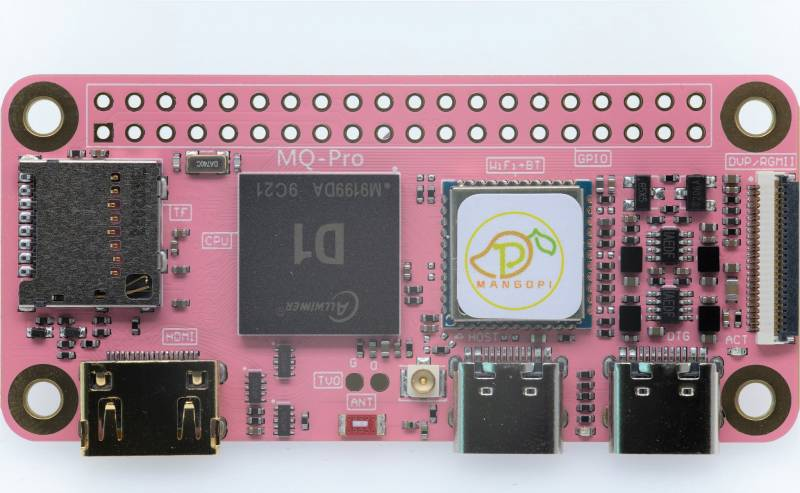
The Mango Pi board is a compact single-board computer (SBC) designed for developers, hobbyists, and tech enthusiasts. It offers a range of features and specifications that make it a powerful yet affordable choice for various applications.
Specifications
The Mango Pi MQ-Pro is equipped with impressive hardware:
Processor: Allwinner D1 (RISC-V core) running at up to 1GHz.
RAM: Available in two versions—512MB DDR3 or 1GB DDR3L.
Connectivity: Onboard WiFi and Bluetooth, USB Type-C ports for OTG and USB Host, and a 40-pin Raspberry Pi-compatible GPIO header.
Storage: MicroSD card slot with optional NAND storage.
Video and Audio: Mini HDMI port supporting up to 4K resolution, audio output pads, and onboard microphones.
Size: Compact dimensions of 65mm x 30mm.
Usability
The Mango Pi MQ-Pro is designed to run Linux distributions like Tina-Linux and Debian, making it suitable for a wide range of applications. It supports Python programming and Linux ecosystems, enabling users to develop software, automate tasks, and experiment with IoT projects.
Applications
This SBC is ideal for:
Home Automation: Control smart devices and sensors.
Industrial Control Systems: Manage machinery and processes.
Educational Projects: Learn programming and electronics.
Media Centers: Stream videos and music with a simple 2D interface.
Why It's a Good Buy
The Mango Pi MQ-Pro stands out for its affordability, versatility, and compact design. It offers features comparable to the Raspberry Pi Zero W but with the added benefit of RISC-V architecture, which is gaining popularity for its open-source nature. Its onboard WiFi and Bluetooth make it easy to connect to networks and devices.
Pricing and Availability
The Mango Pi MQ-Pro is available at competitive prices:
Amazon: Starting at $35.90.
AliExpress: As low as $20.78.
Crowd Supply: Around $39.
You can purchase the Mango Pi board from platforms like Amazon, AliExpress, and Crowd Supply. It is widely available and ships within a few days.
The Mango Pi board is a fantastic choice for anyone looking to explore the world of SBCs, whether for personal projects or professional development. Its combination of affordability, functionality, and compact design makes it a worthy investment. Ready to dive into the world of Mango Pi? 🍊📟


Comments
Post a Comment